Looking beyond the miracle stories to discover the ordinary people Jesus chose to change the world.
(Plus Interview with Randal Teague)
Sometimes we become so familiar with the stories of Scripture that we stop noticing the people who lived them.
Peter climbs out of the boat. Andrew leaves his nets. James and John walk away from their father’s fishing business. We’ve heard these accounts since childhood, and because we know how the story ends, it’s easy to overlook what these men left behind. We often see them as heroes before remembering they were simply ordinary people trying to make a living.
Perhaps that’s why Jesus’ invitation still amazes me.
He didn’t begin His ministry by gathering scholars, political leaders, or society’s elite. He walked along the shores of Galilee and called fishermen.
As I spoke with author Randal Teague about his new book, Jesus and His Fisherman: The Untold Story, I found myself looking at these familiar passages through fresh eyes. His research explores the historical world surrounding Jesus’ first disciples—the economic hardships they endured, the heavy taxation imposed by Rome and Herod, and the daily uncertainty that shaped their lives. Understanding their circumstances doesn’t diminish the miracles of Scripture; it magnifies God’s grace.
These weren’t men living comfortable lives while waiting for something more exciting to happen. They were hardworking laborers carrying responsibilities, supporting families, and navigating a culture filled with political oppression and financial strain. In many ways, their lives resemble our own more than we sometimes realize.
We know what it feels like to wake up carrying concerns about the future. We understand the weight of responsibilities that never seem to end. We live in a world where uncertainty often feels like a constant companion.
Yet it was into that very reality that Jesus spoke four simple words:
“Follow me.”
Not after life became easier. Not after they had everything figured out or circumstances improved.
Simply, “Follow me.”
That invitation echoes across the centuries because it has never depended on perfect conditions. It has always depended on a willing heart.
One of the insights that stayed with me from my conversation with Randal was his reminder that fishing itself became one of Jesus’ greatest teaching tools. Patience. Perseverance. Trust. Long hours with no visible results. The willingness to cast the nets again after disappointment. These weren’t merely occupational skills—they became spiritual lessons that shaped the men who would one day help spread the Gospel throughout the world.
I wonder if that’s still true today.
Perhaps God is doing some of His deepest work in us during seasons that feel repetitive or unseen. Perhaps the ordinary routines we sometimes wish away are quietly forming the character needed for the calling He has prepared.
Paul reminds us, “We live by faith, not by sight” (2 Corinthians 5:7). Fishermen understood that long before they became disciples. Every morning they pushed away from shore without knowing what the day would bring. They worked with hope before they ever saw the catch.
Isn’t that what faith often looks like?
Not certainty, but obedience.
Not control, but trust.
Not knowing every answer, but believing the One who does.
As our conversation continued, another thought lingered in my heart. Randal emphasized that many Christians know Jesus’ miracles but know very little about the world in which those miracles took place. Understanding the geography of Galilee, the pressures of Roman rule, and the Jewish culture surrounding Jesus doesn’t replace faith—it enriches it. The Gospel becomes even more beautiful when we recognize that God entered a real world filled with real people facing real struggles.
That truth encourages me.
Sometimes we imagine that God works best in ideal circumstances. We wait until life settles down before believing He can use us. But the first disciples remind us otherwise. Jesus stepped into lives marked by exhaustion, uncertainty, financial pressure, and unanswered questions. He didn’t avoid ordinary people; He intentionally chose them.
The same Lord who stood beside the Sea of Galilee still walks beside us today.
He sees the mother wondering if she’s enough for her children and the business owner carrying burdens no one else understands.
He sees the caregiver who feels unseen, the student searching for purpose, the believer quietly praying for a prodigal child to come home.
None of those circumstances disqualifies us from His calling. If anything, they become the very places where His grace shines brightest.
Indeed, one of the most beautiful themes throughout Scripture is that God delights in using ordinary people for extraordinary purposes. Moses questioned his ability. David was the overlooked shepherd boy. Ruth was a foreign widow. The disciples were fishermen whose names history might never have remembered had Jesus not called them.
As Paul wrote, “God chose the foolish things of the world to shame the wise; God chose the weak things of the world to shame the strong” (1 Corinthians 1:27).
The Kingdom of God has never advanced because people were impressive. It advances because people are willing.
Perhaps that’s why the image of fishermen continues to resonate after two thousand years. Fishing requires patience when nothing seems to be happening. It requires endurance after disappointment. It requires faith that another cast may bring a different result. Our walk with Christ often feels much the same.
There are seasons when prayers seem unanswered, when growth feels slow, or when obedience goes unnoticed. Yet Jesus never promised instant results. He promised His presence.
“I am with you always,” He said (Matthew 28:20).
That promise is enough.
Reading the Gospels through the eyes of those first fishermen reminds us that Christianity was never intended to be merely admired from a distance. It is an invitation to step into the boat, trust the Savior, and follow wherever He leads.
Their story is not simply history.
It is our story.
Because every believer, regardless of background, receives the same invitation that echoed across the waters of Galilee so long ago: “Follow Me.”
And perhaps the greatest miracle isn’t that Jesus transformed fishermen into disciples. It’s that He continues transforming ordinary people like you and me.
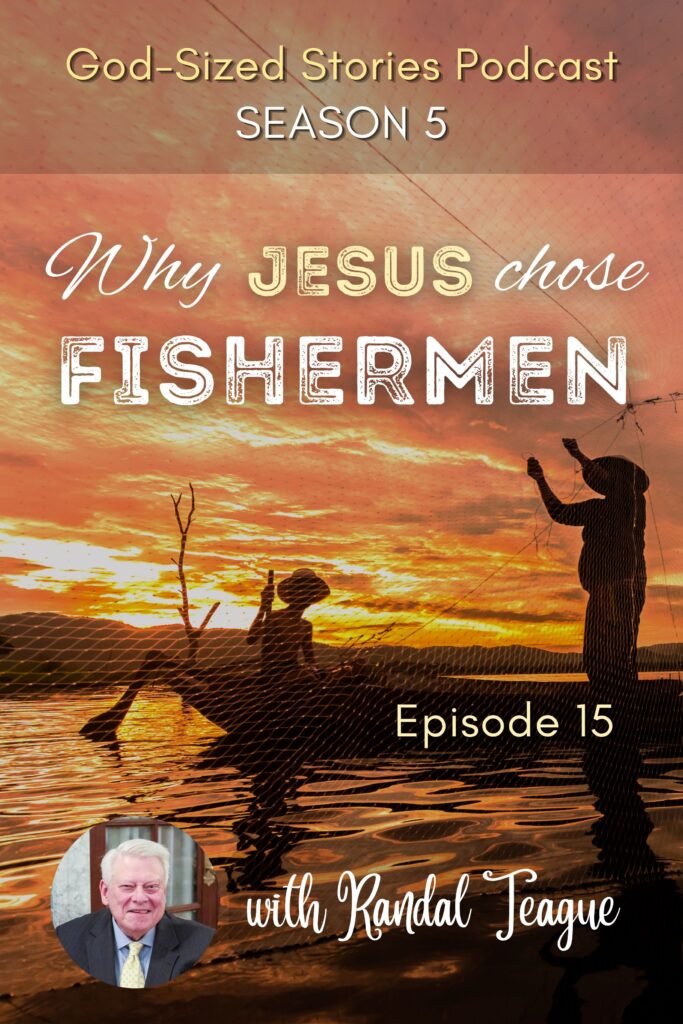
INTERVIEW AND GIVEAWAY: If you’d like to hear more of this fascinating conversation with Randal Teague and discover how understanding the lives of Jesus’ first disciples can deepen your own walk with Christ, I invite you to watch the full interview or listen to this episode of God-Sized Stories with Patricia Holbrook below. I believe you’ll come away reading the Gospels with fresh eyes—and an even deeper appreciation for the Savior who still calls ordinary people to extraordinary faith.
FIND OUT MORE:
- Purchase the book: Jesus and His Fishermen
- Watch the interview below and ENTER THE GIVEAWAY from the form at the end of this post.