Understanding church hurt, processing the pain, and learning to trust again
(Plus Interview with Timothy St. John)
There are some wounds that are especially difficult to explain because they happened in a place where we never expected to be wounded.
The church is supposed to be a safe space. A place where we find grace, truth, community, prayer, and the blessing of godly relationships. It is where we bring our burdens, celebrate one another’s joys, and learn together what it means to follow Jesus.
So what happens when the church itself becomes a source of pain?
For some, it is a broken trust that may even be translated into sexual or emotional abuse. For others, the abuse may not be criminal but nevertheless harmful: public shaming, intimidation, or leadership deception. To make matters worse, the issue is often engulfed by a culture that minimizes what should have been confronted.
Circumstances can differ, but the ache underneath can be remarkably similar: If this happened in the church, where do I go now?
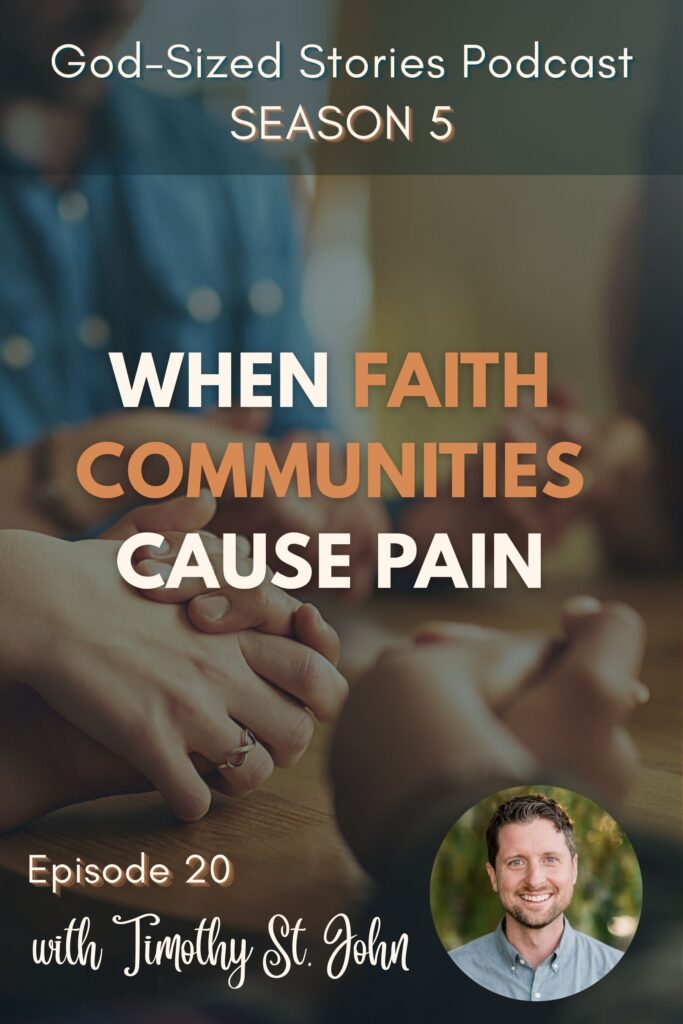
That is one of the questions Timothy St. John addresses in his book After Church Hurt: Healing in the Care of the Good Shepherd. As a counseling pastor, Tim has walked alongside people carrying wounds from church experiences, and in our conversation, he offered what those who have been hurt often need desperately: a way to express the depth of one’s hurt, and a path toward healing. The book describes church hurt as unrepentant sin that a church culture and its leadership minimize, normalize, or even (shamefully) silently support.
One of the things that struck me most in our conversation was how church hurt rarely stops with the original wound.
There can be the initial pain—the anxiety, grief, confusion, or betrayal. Then there can be the pain of realizing that what happened may not be acknowledged or addressed. And sometimes there is another loss altogether: relationships and community.
You may leave the church because you need to. But leaving does not necessarily mean the loneliness disappears.
Sometimes it grows.
And this is where the tenderness of Scripture matters.
Psalm 23 does not give us a picture of a distant God who watches suffering from afar. It gives us the image of a Shepherd who leads, restores, accompanies, and cares for His sheep. “He restores my soul,” David writes.
Not He tells me my pain does not matter. Not He asks me to pretend it never happened.
He restores.
Wisdom lies in recognizing that healing does not mean minimizing what happened. Tim encourages people to process their experiences honestly and, when appropriate, seek wise help rather than allowing pain to remain hidden or become a source of isolation.
He also talks about the difficult question of returning to church.
For someone who has been hurt, walking through the doors of another church can feel like stepping into a place where the floor might give way again. Trust does not return simply because someone says, “You can trust us.” Character takes time to see. That is why Tim encourages people to move slowly, ask questions, bring someone they trust, and pay attention not only to what a church teaches but to how its leaders and people live.
There is something deeply biblical about that.
The church is not built around one leader’s personality. Christ is the head of His body. Paul reminds us in 1 Corinthians 12 that every part matters—including those the world might consider weak or less important. And as James tells us, “God opposes the proud but gives grace to the humble.”
Humility matters. Accountability matters. Care matters. And when those things are missing, pretending otherwise does not make the church healthier. It deepens the issue and weakens God’s church.
Another important truth Timothy and I spoke about is this: people’s failures do not change Jesus’ character.
Oh, how I wish every soul hurt by a Christian led by the flesh (or used by the enemy) would grasp this truth deep within his or her heart!
It’s a truth that has the power to start the healing process: A pastor may disappoint us. A church culture may fail us. Someone entrusted with spiritual authority may misuse it. But Jesus remains the Good Shepherd.
He is not the one who wounded you. He is the One who comes near to the wounded.
That distinction may take time to believe again.
Perhaps you are reading this because church hurt is part of your story. Perhaps you have been away from church for months or years, unsure whether you can trust another congregation. Or perhaps you are a pastor, counselor, friend, or family member trying to understand how to walk beside someone who has been wounded.
Wherever you find yourself, there is hope.
Healing does not mean forgetting. And it may not mean returning to the same place or happen as quickly as we wish.
But healing can mean that the wound no longer has the final word.
The Shepherd still knows His sheep. And He is still leading wounded hearts toward green pastures, still waters, truth, grace, and community.
Listen to or watch my full conversation with Timothy St. John to hear more about church hurt, healing, rebuilding trust, and finding healthy Christian community. His book, After Church Hurt: Healing in the Care of the Good Shepherd, offers practical biblical guidance for those who have been wounded, as well as for pastors, counselors, and those walking alongside them.
FIND OUT MORE:
- Purchase the book: After Church Hurt
- Watch the interview below and ENTER THE GIVEAWAY from the form at the end of this post.