Guiding children to understand identity, sexuality, and truth through a biblical worldview
(plus my conversation with Elizabeth Urbanowicz, teacher, author, speaker, founder and CEO of Foundation Worldview)
I still remember the first time one of my daughters asked a question I wasn’t prepared to answer. Not because the question itself was impossible, but because it arrived years before I expected it.
Parenting has a way of exposing our assumptions. We imagine there will be time. Time to prepare. Time to learn. Time to find the right words. Then life places us in a moment we didn’t anticipate, and suddenly we are searching for wisdom while our child is searching our face for answers.
Many parents today know that feeling. But the questions I faced 15 years ago do not compare with what parents face today.
Questions about identity, sexuality, gender, relationships, and truth are arising earlier than in previous generations. What once felt like conversations reserved for adolescence are now appearing in elementary school classrooms, on playgrounds, in social media feeds, and in children’s television programming.
For many Christian parents, the challenge isn’t a lack of conviction. It’s a lack of confidence.
How do we discuss these topics without fear?
How do we remain faithful to Scripture while extending compassion?
How do we prepare our children for a world that often presents a very different story than the one found in God’s Word?
Those questions were at the heart of my recent conversation with educator, apologist, and Foundation Worldview founder Elizabeth Urbanowicz.
GOD’S GOOD DESIGN
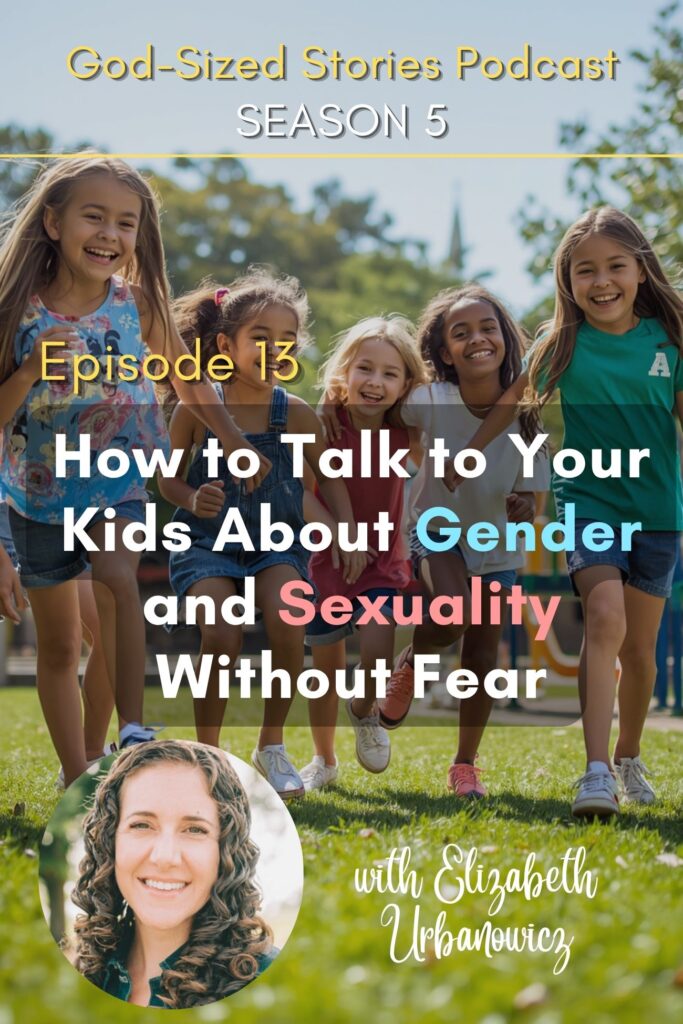
Elizabeth has spent years helping parents, teachers, and church leaders equip children with a biblical worldview. Her latest book, Helping Your Kids Know God’s Good Design: 40 Questions and Answers on Sexuality and Gender, was born out of countless conversations with parents who felt overwhelmed by the cultural landscape their children were navigating.
Elizabeth’s approach is to create an environment where parents can start hard conversations without fear. Because conversations are starting earlier than ever before
Many parents assume they should wait until their children are older before discussing topics related to sexuality. Elizabeth gently challenged that assumption, encouraging parents to become the first trusted voice in their children’s lives.
Her reasoning was both practical and profound.
Whoever introduces a subject often becomes the expert in a child’s mind.
That insight stayed with me. Because it is so very true: If we want our children to come to us with their questions, fears, and confusion, we cannot afford to surrender those first conversations to the culture. If we do, culture will certainly rise to the task.
Deuteronomy 6:7-8 paints a beautiful picture of faith being woven into everyday life:
“These words, which I am commanding you today, shall be on your heart. And you shall repeat them diligently to your sons and speak of them when you sit in your house, when you walk on the road, when you lie down, and when you get up.“
This passage doesn’t describe one dramatic conversation. It describes a lifestyle of discipleship.
What Moses taught the Israelites as they started their journey as a people is sound wisdom for today: Truth is not delivered in a single lecture. Rather, it is cultivated over thousands of ordinary moments.
That perspective removes much of the pressure many parents feel. We do not need to deliver a perfect speech. We simply need to remain present, prayerful, and willing to engage.
Elizabeth repeatedly returned to the idea of God’s good design.
I love that phrase.
In a culture where conversations about sexuality often begin with warnings, fears, and controversy, she begins with God’s goodness. That is where Scripture begins as well.
Before sin entered the world, before confusion clouded identity, before brokenness distorted relationships, God looked upon His creation and declared it good.
Children need to know that truth.
They need to understand that God’s design for our bodies, our relationships, and our identity is not arbitrary. It flows from the heart of a loving Creator who knows us completely, loves us deeply, and whose heart for His people is grounded in protection and a life filled with His presence and peace.
As parents and caregivers, our role is not merely to protect children from harmful ideas. Our role is to introduce them to something better.
To something true. To Someone true.
The goal is not fear-based parenting. It is faithful discipleship. And perhaps that is the encouragement many of us need today.
We do not have to navigate these conversations alone. God has not abandoned parents to figure this out on their own. He promises wisdom to those who ask. He provides His Word as a lamp for our feet (Psalm 119:105). And He remains faithful to guide us as we guide the children entrusted to our care.
The cultural landscape may continue to shift, but God’s truth has not changed. His design is still good. His wisdom is still trustworthy.
And His grace is still sufficient for every conversation we feel unprepared to have.
If this topic resonates with you, I encourage you to listen to my full conversation with Elizabeth Urbanowicz. Her practical insights, biblical wisdom, and compassionate approach offer valuable guidance for parents, grandparents, teachers, and anyone seeking to help the next generation navigate today’s culture with confidence rooted in God’s truth.
FIND OUT MORE:
- Purchase the book: Helping Your Kids Know God’s Good Design: 40 Questions and Answers on Sexuality and Gender
- Watch the interview below and ENTER THE GIVEAWAY from the form at the end of this post.