What Scripture Teaches Us About Seeing the Broken the Way God Does
(Plus my Interview with Jonathan Tepper about his new book, Shooting Up)
“While we were still sinners, Christ died for us.”
— Romans 5:8
There are places most of us would rather not go.
Not physically—and certainly not emotionally.
Places where brokenness is not hidden behind closed doors but spills into the streets. Where pain has a name, a face, and often a smell. Where people carry stories so heavy, we instinctively look away.
And yet, those are the very places Jesus walked toward.
Not away from.
Toward.
We see it again and again in Scripture—Jesus touching lepers, speaking with the outcast, sitting with sinners, allowing Himself to be interrupted by the desperate and the forgotten. He did not wait for people to clean themselves up before drawing near. He entered their mess.
Because that is where love is most needed.
And perhaps, if we are honest, that is also where love feels most costly.
The Kind of Love That Crosses the Street
In the parable of the Good Samaritan (Luke 10:25–37), the religious leaders passed by.
They saw. But they did not stop.
The Samaritan, however, crossed the road.
He moved toward the wounded man, not away from him. He allowed compassion to inconvenience him. Scripture says:
“When he saw him, he had compassion.” (Luke 10:33)
Compassion, in the biblical sense, is not a fleeting emotion. It is a movement of the heart that leads to action.
It costs something. Time. Comfort. Safety. Control. And sometimes, it costs our assumptions about who is “worthy” of that kind of love.
When Brokenness Feels Too Close
There is a reason we often keep a safe distance from deep brokenness.
Because it confronts us. It reminds us that the world is not as orderly as we would like it to be. That pain is real. That healing is not always immediate. That people do not always respond the way we hope.
But we must remember the way of the cross, beautifully foreshadowed throughout Jesus’ life. Indeed, the Man of Sorrow shows us that the gospel was never meant to be carried only into comfortable spaces. It was always meant for the margins. For the sick and the hopeless.
In Matthew 9:12–13, He said:
“It is not the healthy who need a doctor, but the sick… For I have not come to call the righteous, but sinners.”
The gospel was never meant to be carried only into comfortable spaces.
It was always meant for the margins.
A Modern Story That Reflects an Ancient Truth
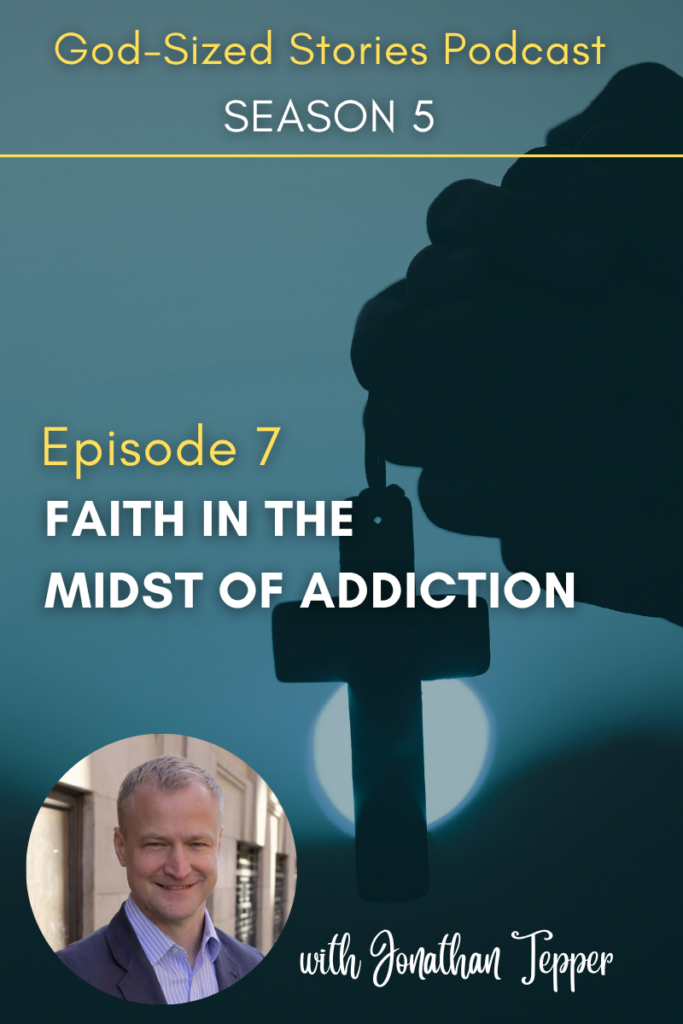
In this week’s episode of God-Sized Stories, I sit down with Jonathan Tepper, whose childhood unfolded in the middle of one of those “hard places.”
Raised by missionary parents in a community marked by addiction and despair, Jonathan did not just hear about the gospel—he saw it lived out.
Day after day.
In recovery homes.
In conversations with those the world had given up on.
In the quiet, consistent choice to stay present in places others avoided.
His story, shared in his book Shooting Up, is not just about addiction—it is about proximity. It’s about what happens when believers choose not to turn away and what it looks like to love people not from a distance, but up close.
And it raises a question we cannot ignore:
Where might God be calling us to step closer rather than step back?
The Courage to See Differently
Seeing people the way God sees them requires something more than empathy. It requires surrender. Because when we begin to see others through the lens of the gospel, we realize that we were never the “safe” ones either.
Ephesians 2:4–5 reminds us:
“But because of His great love for us, God, who is rich in mercy, made us alive with Christ even when we were dead in transgressions…”
We were the ones in need of rescue.
And God did not hesitate. He stepped into our darkness fully, sacrificially, and without reservation.
A Gentle Invitation
Not all of us are called to the same places, but all of us are called to the same kind of Agape (sacrificial) love.
A love that notices. A love that invites the broken in instead of avoiding them. A love that steps in, even when their brokenness feels foreign to us.
Maybe for you, that place is not a recovery home in Madrid. Or a shelter for battered women, as the one where my ministry serves.
Maybe your hard place is a difficult relationship.
A hurting neighbor.
A family member you have kept at arm’s length.
Or perhaps it is simply asking God to soften your heart toward people you have unknowingly overlooked.