Why Anxiety Is Not Spiritual Disqualification
(Featuring my interview with Ed Welch)
Then Gideon said to God, “Do not let Your anger burn against me that I may speak once more; please let me make a test once more with the fleece…” (Judges 6:39).
I have always found honesty a priceless commodity in relationships. I want honesty when it comes to my marriage, friendships, and my children. I am the type of person who will hardly feel offended by an honest opinion, and if I cannot be honest with you and vice versa, well, I don’t think we are truly friends.
But I have to say—when it comes to telling God about my hesitation and honestly admitting that I need more confirmation before moving forward, I used to consider it a faith flaw.
Until one day, when I came across the story of Gideon, at a time when I was truly not sure what the Lord wanted me to do.
When the Angel of the Lord visited Gideon while he was threshing wheat in a winepress to hide from Israel’s enemies, He called him a mighty warrior and declared that he would be used to defeat Midian. That declaration stunned the baby of the family:
“Pardon me, my lord,” Gideon replied, “but how can I save Israel? My clan is the weakest in Manasseh, and I am the least in my family.”
The story is told in Judges 6, and it has become one of my favorite stories in the Old Testament. The unlikely hero who hesitated, even after witnessing miraculous deeds right before his eyes. The trembling soldier who needed confirmation after confirmation before stepping out into his destiny.
Indeed, Gideon does not sound like a mighty warrior. He sounds like a man whispering, Please don’t be mad at me for asking again. He asks for another sign. And then another. He is not bold; he is unsure. He is not charging into battle; he is testing the ground.
And yet God does not rebuke him. Not once.
Yahweh patiently gives Gideon fresh assurance, time and again.
Don’t you just love that? Scripture does not sanitize fear. It records it. Preserves it. Even dignifies it.
Moses said, “Who am I that I should go to Pharaoh?” (Exodus 3:11). Later, he protested, “I am slow of speech and tongue” (Exodus 4:10).
His fear sounded like inadequacy. Moses’ argument was anchored in a sense of disqualification. His paralysis sprang from a heart that knew that, in his own strength, Israel’s leader was not able.
And again in that story, what does God do?
He does not thunder from heaven, “How dare you!” Rather, He lovingly answers with the assurance of His presence: “I will be with you.”
That has become one of the anchoring truths of my own life: God is not surprised by our fear, nor is He irritated by it. He knows our frame. He remembers we are dust (Psalm 103:14). Fear does not shock Him.
Fear, in Scripture, is often the doorway to deeper revelation.
Over and over, God’s response to fearful people is not rejection but invitation. “Do not be afraid.” Not because fear never exists—but because He does.
When God calls us to something that feels beyond us—speaking truth, forgiving someone who hurt us, stepping into leadership, trusting Him in silence—our instinct is often to shrink back. We wait for certainty. For clarity. For the fleece to be wet or dry one more time.
But courage in the Bible is rarely the absence of fear. It is obedience in the presence of fear.
I have walked through many seasons when answers did not come quickly. When silence felt heavy and obedience felt risky. As a matter of fact, I am walking through one such season right now. During times like this, it brings me great peace to know that fear or hesitation before a difficult decision does not mean a lack of faith. Sometimes it simply means God is inviting us to go deeper still, trembling knees and all.
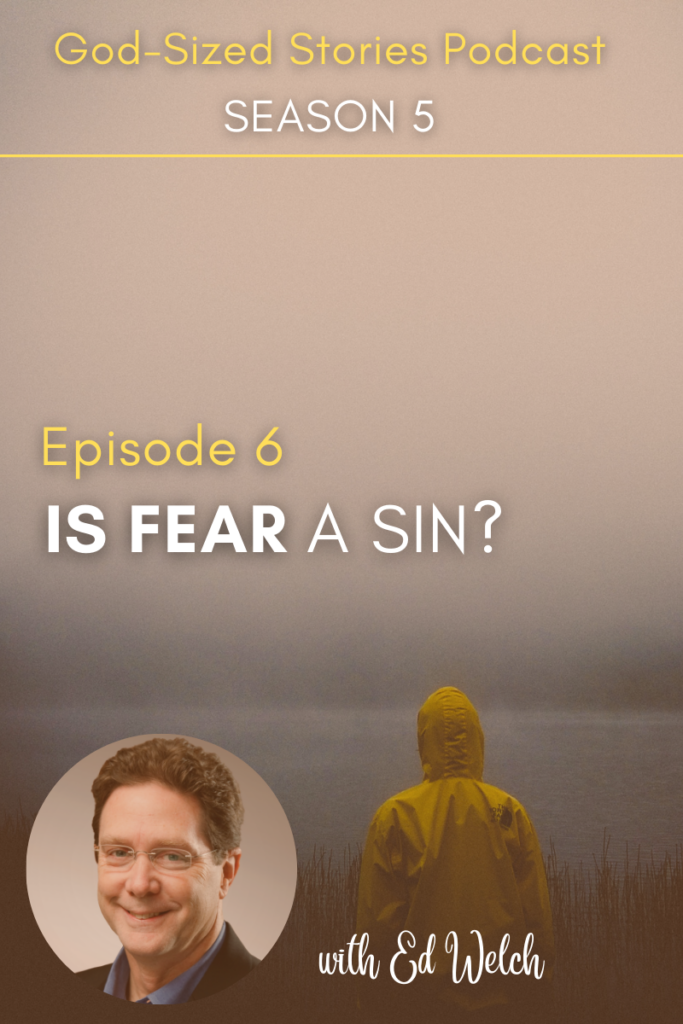
That truth is why my recent conversation with Christian counselor author Ed Welch resonated so deeply with me.
Fear is not a sin
In his book Fear Is Not a Sin, Welch carefully untangles something many believers quietly carry: the guilt of being anxious.
Some of us may read “Do not fear” as a commandment without compassion. We assume our anxiety must mean we are spiritually weak. Welch brings biblical clarity and pastoral gentleness to the conversation. He distinguishes between fear as a human response in a fallen world and fear that turns into hardened unbelief. That distinction matters.
Because if every experience of anxiety is labeled as sin, then struggling believers hide instead of seeking help. But if fear can be a place where we meet God’s tenderness, then it becomes a pathway to growth rather than shame.
If you have ever felt guilty for your anxiety, if you have wondered whether your fear disqualifies you from strong faith, I hope both this reflection and my conversation with Ed Welch will offer you fresh insight and freedom.
Because fear may threaten your peace. It may even shake you. But it does not get the final word.