Charles Spurgeon, Sacred Suffering, and the Hope That Still Holds
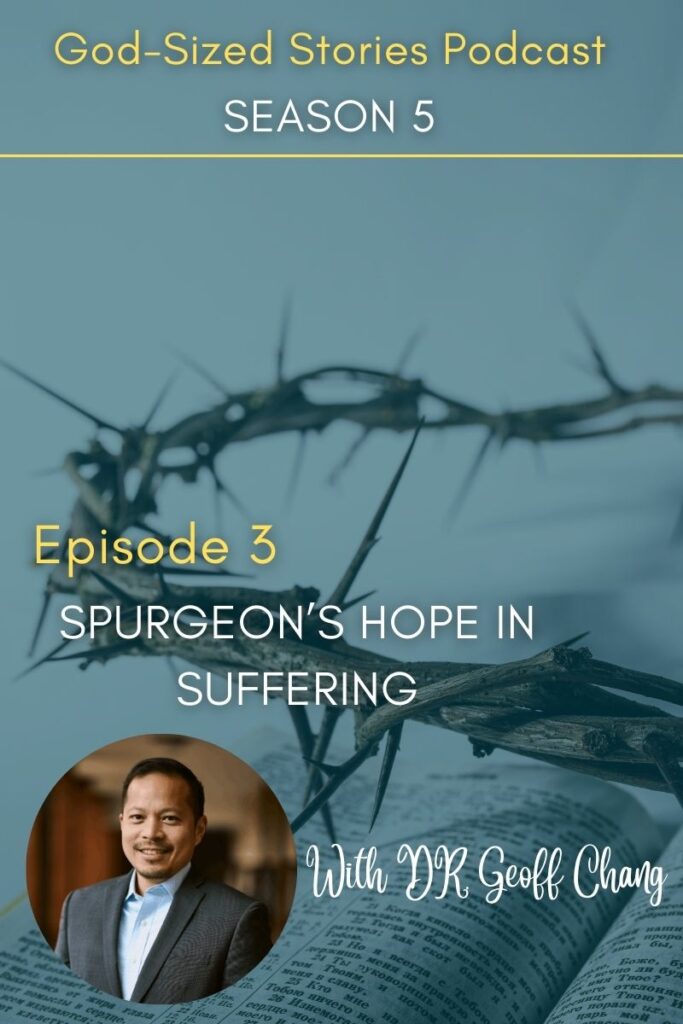
(Featuring my interview with DR. Geoff Chang, author of Your Only Comfort)
Charles Haddon Spurgeon was a nineteenth-century English preacher, writer, and philanthropist whose life and words have guided countless believers during his lifetime and beyond. He remains one of the most influential Christian voices across denominations. Spurgeon pastored the New Park Street Chapel (later known as the Metropolitan Tabernacle) in London for 38 years.
There is hardly a Christian pastor, writer, or Christ-follower who has not been blessed by Spurgeon’s deep theological insights. He was known for publishing weekly sermons and wrote extensively—books, commentaries, devotionals, magazines, and even hymns.
As one reads his life story, Spurgeon’s love for the Lord and zeal for God’s Word are unmistakable. But as God enlarged his territory—at a time when Spurgeon’s congregation was the largest in Europe—the enemy rose against him, even using the church itself to oppose his ministry.
His uncompromising stand for the Bible as the sole infallible authority for Christian faith and practice came to a breaking point in 1887, when Spurgeon chose to disaffiliate from the Baptist Union. A growing wave of skepticism toward scriptural dogma had taken hold of Europe, as beliefs contrary to biblical teaching—such as Charles Darwin’s theory of evolution and other secular philosophies—began dividing clergy and scholars alike. As a result, Spurgeon’s teachings were relentlessly attacked.
His response to this movement infuriated his opponents:
Assuredly the New Theology can do no good towards God or man; it has no adaptation for it. If it were preached for a thousand years by all the most earnest men of the school, it would never renew a soul, nor overcome pride in a single human heart.
But scholarly opposition was not the only source of sorrow for the “Prince of Preachers,” as he had been affectionately nicknamed earlier in his ministry. As much work for the Kingdom as this man accomplished in his 57 years, Spurgeon carried deep sorrow and pain.
Indeed, Spurgeon knew despair—loneliness, physical suffering, and emotional pain. He died watching his beloved Europe being swept by a wave of skepticism and contempt for what he held most sacred. And yet, as one reads his words, one encounters a man content to rest in God’s sovereignty, basking in the presence of the Morning Star.
“God is our refuge and strength,
a very present help in trouble.
Therefore we will not fear…”
— Psalm 46:1–2 (ESV)
Few verses capture the tension between suffering and steadfast hope as clearly as Psalm 46. It is a confession born not of ease, but of pressure—spoken by those who have learned, often painfully, that true comfort is not found in the absence of trouble, but in the presence of God Himself.
It is this kind of hard-won comfort that permeates the life and writings of Charles Spurgeon.
He did not write from the safe distance of theory or abstraction. His words were forged in seasons of profound affliction—physical suffering, public opposition, doctrinal controversy, and deep personal sorrow. Though celebrated as the “Prince of Preachers,” his path was marked by loneliness, depression, and relentless spiritual warfare. And yet, again and again, Spurgeon returned to one unshakable truth: God is sovereign, God is good, and God Himself is the believer’s greatest comfort.
That is precisely why his voice still resonates today.
In my recent conversation with Dr. Geoff Chang, we explored why Spurgeon’s writings remain so spiritually relevant—and how his devotional Your Only Comfort invites modern believers to anchor their hope where Spurgeon anchored his: not in circumstances, clarity, or relief, but in the unchanging character of God. Drawing directly from Spurgeon’s sermons and pastoral reflections, this devotional gently guides readers through suffering with honesty, theological depth, and gospel-centered hope.
At a time when many are searching for comfort on shifting ground, Your Only Comfort—as Dr. Geoff Chang reflects in our conversation—invites us to sit where Spurgeon once sat: wounded, weary, and yet unshaken, finding rest not in answers, but in the unchanging presence of a sovereign God.